Samantha Shay’s
MOTHER MELANCHOLIA
with Barbara Kaufmann, Chalia La Tour, and Breanna O’Mara
Inspired by music from Sóley
Co-commissioned by Tanztheater Wuppertal
Pina Bausch
Virtual On-Demand Screenings from May 9-15, 2022
to
Benefit the Ukrainian People
In-Person World Premiere Screening took
place in Germany: May 7, 2022
Mother Earth is not happy, and
Samantha Shay’s MOTHER MELANCHOLIA expresses her sentiments beautifully
through modern dance, sometimes convulsive and other times in slow surrender,
and the haunting music of Soley. From the poignant eyes of four women who have
witnessed too much, both real and imagined, we see the unthinking devastation of
natural resources and the difficulty getting others to be concerned. They
support one another, commiserating and comforting, while shedding unnecessary
clothing and enjoying what is left. The reality is that you can dress it up any
way you like, but the melancholy is still there. MOTHER MELANCHOLIA
is a stunning rendition of a disturbing destruction.
- Laurie
Lawson -
|
|
Metropolitan Playhouse
Virtual Playhouse
Presents
METROPOLITAN IN MOTION: 2021
Featuring New Works by Choreographers
AMANDA SELWYN,
RACHAEL KOSCH & ADRIANA SANANES,
ANTONIA FRANCESCHI, CATHERINE THARIN, &
HANNAH NEWMAN-PAN
www.MetropolitanPlayhouse.org/metinmotion
Metropolitan
Playhouse at YouTube.com
March 3, 2021, 8 p.m.
Available online through
Saturday, March 6, 2021
Metropolitan Playhouse inaugurates its new series, “The
Wednesday Alternative”, with this contemporary dance production. Presented on
film with great videography, the choreographers strut their signature styles.
First is “The Bells of St. Genevieve” by CATHERINE
THARIN. Dancer Sarah Bauer floats elegantly, a barefoot waif in white, to music
with an exotic eastern vibe. The intriguing “Madam Excerpt”, in contrast, starts
with a hunched, black-shrouded figure (RACHAEL KOSCH) creeping about. She
created the dance with ADRIANA SANANES. Wait for the magic on this one!
“The Kiss of Judas”, choreographed and performed by
HANNAH NEWMAN-PAN, opens a new vista that includes side-by-side film clips and
outdoor performance. Ballet style enters with “Suddenly Singing/Everyone Sang”
to beautiful music played by DANIEL HOPE on violin and JACQUES AMMON on piano.
AMANDA SELWYN and her dancers wrap it up with full orchestral music and multiple
visual frames of dancers in the snow, outdoors, and indoors.
METROPOLITAN IN MOTION: 2021 is just what the doctor
ordered: a “happy pill” to shake off the winter blues. Gorgeous body movement,
sunshine even in the snow. An absolute “upper” for the soul.
-Karen D’Onofrio-
|
|
Works & Process at the
Guggenheim
Presents the
Four-part Docuseries
ISOLATION TO CREATION
By filmmaker NIC PETRY of DANCING CAMERA
Featuring BUBBLE RESIDENCY Artists
EPHRAT ASHERIE DANCE
LES BALLET AFRIK WITH OMARI WILES
THE MISSING ELEMENT WITH CHRIS CELIZ AND ANTHONY
RODRIGUEZ "INVERTEBRATE"
MUSIC FROM THE SOLE WITH GREGORY RICHARDSON & LEONARDO
SANDOVAL
JAMAR ROBERTS
SEVEN DEADLY SINS WITH JOSHUA BERGASSE, JUSTIN VIVIAN
BOND, JEFFREY GUIMOND, MARC HAPPEL, & SARA MEARNS
Airing on WNET's ALL ARTS
Streaming nationwide February 17, at 8 p m. EST
EPISODE FOUR: SHOWTIME
allarts.org
It’s Episode Four, and time to pack up and go home, back
to the city. The performers got outside into the sunshine for some final antics,
stretches, and tap-offs. OMARI WILES of LES BALLET AFRIK calls it “euphoria”.
The artists were permitted to perform outdoors for a small audience at Kaatsbaan
Cultural Park. Joy for all.
Performances were filmed at the Kaatsbaan Festival.
Others were filmed outdoors at Lincoln Center in quarantined conditions,
allowing the performers to work without masks. The exciting results will
premiere live at the Guggenheim when health regulations permit.
During all of
this, everyone was COVID-tested again and again, always with negative results.
The participants and sponsors are proud to announce that their quarantine
protocols worked perfectly. They have established a process that can be
duplicated by others to further artistic interaction during this pandemic.
Lead funding for Works & Process is provided by the Ford
Foundation, the Christian Humann Foundation, Leon Levy Foundation, Mertz Gilmore
Foundation, NYC COVID-19 Response and Impact Fund, Stavros Niarchos Foundation,
Rockefeller Brothers Fund, and Evelyn Sharp Foundation. The New York City
Department of Cultural Affairs, in partnership with the City Council and the
National Endowment for the Arts, supplied public funds. The U.S. Small Business
Administration Paycheck Protection Program and NYC Employee Retention Grant
Program also provided financial assistance.
A wonderful, inspiring accomplishment by everyone!
-Karen D’Onofrio-
|
|
Works & Process at the
Guggenheim
Presents the
Four-part Docuseries
ISOLATION TO CREATION
By filmmaker NIC PETRY of DANCING CAMERA
Featuring
BUBBLE RESIDENCY Artists
EPHRAT ASHERIE DANCE
LES BALLET AFRIK WITH OMARI WILES
THE MISSING ELEMENT WITH CHRIS CELIZ AND ANTHONY
RODRIGUEZ "INVERTEBRATE"
MUSIC FROM THE SOLE WITH GREGORY RICHARDSON & LEONARDO
SANDOVAL
JAMAR ROBERTS
SEVEN DEADLY SINS WITH JOSHUA BERGASSE, JUSTIN VIVIAN
BOND, JEFFREY GUIMOND, MARC HAPPEL, & SARA MEARNS
Airing on WNET's ALL ARTS
Streaming nationwide February10 & 17, at 8 p m. EST
EPISODE THREE: AFRIK, BALLET, BALLROOM,
BROADWAY, CLUB, HOUSE, & VOGUE
February 10, 2021 8 p.m. EST
allarts.org,
It’s all coming together now. Each of the bubble
residencies is transforming energy and imagination into movement and music. Soon
they will be ready for their public outdoor performance in the Hudson Valley.
One bubble is breaking and freestyling so intensely that
they “almost black-out”. Total commitment of muscle movement free of conscient
thought. Solid emotion. Their world is that of the classic underground dancers
whose lineage is defined by diversity, embracing and freeing those who were
ethnic and members of the LGBT community.
LES BALLETS AFRIK swirls and blends the power of tribal
dance with the elegance of ballroom. Director OMARI WILES provides guidance,
then lets the dancers create at will, with amazing results.
The revival of SEVEN DEADLY SINS promises to be a smash.
Written by Kurt Weill and Bertolt Brecht in 1933, it is referred to as a “sung
ballet”. Imagine a split-personality plot and vocals written for Lotte Lenya.
Throw in some jazz sax and tap freestyling around the
campfire, and enjoy this episode!
Once again, thank you to the Emmy-winning ALL ARTS, the
New York arts and culture hub created by WNET, for documenting this amazing
work. The performers are outstanding in rehearsals. The finished performances
promises to be awe-inspiring.
-Karen D’Onofrio-
|
|
Works & Process at the
Guggenheim
Presents
The Four-part
Docuseries
ISOLATION TO CREATION
By filmmaker NIC PETRY of DANCING CAMERA
Featuring BUBBLE RESIDENCY Artists
EPHRAT ASHERIE DANCE
LES BALLET AFRIK WITH OMARI WILES
THE MISSING ELEMENT WITH CHRIS CELIZ AND ANTHONY
RODRIGUEZ "INVERTEBRATE"
MUSIC FROM THE SOLE WITH GREGORY RICHARDSON & LEONARDO
SANDOVAL
JAMAR ROBERTS
SEVEN DEADLY SINS WITH JOSHUA BERGASSE, JUSTIN VIVIAN
BOND, JEFFREY GUIMOND, MARC HAPPEL, & SARA MEARNS
Airing on WNET's ALL ARTS
Streaming nationwide February 3, 10, and 17 at 8 p m. EST
EPISODE TWO: BEATBOX, MODERN, STREET, TAP
DANCE, AND AFRO-BRAZILIAN RHYTHM
February 3, 2021 8 p.m. EST
allarts.org.
In this episode, BEATBOX, MODERN, STREET, TAP
DANCE, AND AFRO-BRAZILIAN RHYTHM, we glimpse the creative process
within the eight WORKS & PROCESS “bubble residencies”. The artists from MISSING
ELEMENT meld beatbox, breaking, flexn, and krumping. MUSIC FROM THE SOLE works
on perfecting its “salad of cultures”. JAMAR ROBERTS shares his 17 years of
experience with Alvin Ailey’s Dance Theater to push his group to dig backward
and move forward, all in the present. EPHRAT ASHERIE jumps in with high energy
hip-hop.
Amazing talent and energy here. Enthusiasm in the face of
COVID. The bubble residencies give each group a completely safe environment in
which to interact. No masks needed. Freedom inside and outside in the acres of
Hudson Valley greenery.
The performers’ styles are incredibly diverse and
innovative. This series is the best. It turns viewers on to the ultra-modern and
gives us all a much-needed jolt of optimism.
WORKS & PROCESS pioneered the “bubble residencies” in the
summer of 2020. Under protocols developed with Dr. Wendy Ziecheck and ethical
oversight by Dr. Robert Klitzman, artists isolated by the pandemic gathered
together in COVID-free quarantine to expand their visions. The jointly
subsidized residencies were produced in partnership with Kaatsbaan Cultural
Park, Mount Tremper Arts, and Petronio Residency Center.
-Karen D’Onofrio-
Works & Process at the Guggenheim Presents the Premiere
of the Four-part Docuseries
ISOLATION TO CREATION
By filmmaker NIC PETRY of DANCING CAMERA
Featuring Bubble Residency Artists
EPHRAT ASHERIE DANCE
LES BALLET AFRIK WITH OMARI WILES
THE MISSING ELEMENT WITH CHRIS CELIZ AND ANTHONY
RODRIGUEZ "INVERTEBRATE"
MUSIC FROM THE SOLE WITH GREGORY RICHARDSON & LEONARDO
SANDOVAL
JAMAR ROBERTS
SEVEN DEADLY SINS WITH JOSHUA BERGASSE, JUSTIN VIVIAN
BOND, JEFFREY GUIMOND, MARC HAPPEL, & SARA MEARNS
Airing on WNET's ALL ARTS
Streaming nationwide January 27 and February 3, 10, and
17, at 8 p m. EST
EPISODE ONE: A WAY FORWARD
January 27, 2021 8 p.m. EST
allarts.org,
January, 2020. The start of an amazing new year full of
creativity, invention, performance, and surprise. Or so thought WORKS & PROCESS
at the Guggenheim. Of course, we all know what happened. Seemingly overnight the
COVID pandemic took over the world.
With their performers stifling in self-isolation, WORKS &
PROCESS forged a path for artists to safely gather, create, and perform. After
months of research and consultation, in the summer of 2020 they pioneered a
series of “bubble residencies”. Under a protocol developed with medical counsel
Dr. Wendy Ziecheck, and ethical oversight by Dr. Robert Klitzman, artists
isolated by the pandemic gathered in quarantine in the Hudson Valley. In
partnership with Kaatsbaan Cultural Park, Mount Tremper Arts, and Petronio
Residency Center, through jointly subsidized residencies, eight creative bubbles
were born.
Episode One chronicles the process of “bubble” creation.
Individual COVID testing, ensuring that every venue was “sterile”, finding a
safe bus and driver to take them all to their “bubbles”. Quite complicated,
quite thorough. Amazing, really. It is a joy to see the smiles on their faces.
Freedom to interact and create! In front of a live audience!
Now to create and develop their performances. Styles
include beatbox, krumping, flexing, Afro-Brazilian tap, New York street and club
dance, vogue ballroom, and a revival of the 1933 musical “The Seven Deadly
Sins”. The next episodes in the series will follow their progress. A must-see
for anyone who loves the arts. Out-of-the-box, onto the stage, it is enchanting
to see the drive, energy, and spirit that flows through these performers.
A big thank you to the Emmy-winning ALL ARTS, the New
York arts and culture hub created by WNET, for documenting what can be
accomplished, even in the worst of times.
-Karen D’Onofrio-
The Sheen Center for Thought
and Culture
Justice Film
Festival Summer Films
presents
Owls Media
SKID ROW MARATHON
By GABRIELE & MARK HAYES
Directed by MARK HAYES
https://www.sheencenter.org/shows/skidrow/all/
https://www.youtube.com/watch?v=eUqqKkZE7Kw&live=1
https://www.youtube.com/watch?v=z7DmRTjqrjU&live=1
Meet
L.A. criminal court judge and former prosecutor Craig J. Mitchell. He is
intelligent, dedicated to justice, a devoted husband and father, a devout
Catholic, and immensely creative. His career involved years of sentencing the
guilty to prison, yet he never lost hope for any of them. He felt that each had
potential for good, for a new beginning. His optimism led him to create a
project. A long-shot sort of project. A project to motivate those paroled to the
Midnight Mission down on skid row. His wife was nervous. Five a.m., in the dark,
skid row? Judge Mitchell went for it. He was certain that he could do some good.
He was beyond correct.
Judge Mitchell started a “running club”. Anyone
paroled to the mission could join. Just meet him at the appointed time and
“waddle a little way” with him. Bit by bit more people joined, could run longer
distances, keep up a faster pace. They loved the sense of community it gave
them, the sense of purpose, the sense of self-worth. These runners had been drug
addicts, gang members, street drunks, every kind of criminal. Had done years in
prison. They had found a purpose, a goal.
The project expanded to include
participation in marathons. The judge worked some fundraising magic and took a
small group to a race in Ghana. He wanted to expose them to the larger world, to
other cultures, to things they had never dreamed of. Their smiles are wonderful.
Their amazement is incredible to see.
Some fell back to their old ways,
of course, as the Judge knew some would. But it was all about hope. This film is
a must-see. It will put a smile on your face and joy in your heart.
-Karen D’Onofrio-
A MAY SKY PICTURE ENTERTAINMENT presents
A C. FRASER PRESS/DARREN PRESS film
THERESA IS A MOTHER
www.TheresaIsAMother.com
Starring
EDIE McCLURG, C. FRASER PRESS, RICHARD POE
MATTHEW GUMLEY, ROBERT TURANO, ELAINE BROMKA
And introducing
SCHUYLER IONA PRESS, MAEVE PRESS and AMAYA PRESS
Music based upon the original songs by SCHUYLER IONA PRESS
Music arranged by JOHN FERRARA and GAABE SCHNIDER
Editor: CHAD SMITH
Set Designed by CAMERON STERN
Costumes Designed by LAUREN OPPELT
Director of Photography: ALEX KORNREICH
Sound by CJ DeGENNARO
Associate Producer: CHRISTINA POWERS
Produced by DARREN PRESS
Written by C. FRASER PRESS
Directed by C. FRASER PRESS & DARREN PRESS
To Theresa (C. Fraser Press) life is a song. You may find it at a
Laundromat, in a Gospel kitchen, or on an iPod. Although her life-long dream of
being a professional musician has remained unfulfilled, the beat goes on against
all odds as pesky details like rent and bills persist. In a last-ditch attempt
at survival Theresa packs up her three children (Schuyler Iona Press, Maeve
Press, Amaya Press) and leaves New York City to return to her rural
childhood home. Her parents (the delightful Edie McClurg and Richard
Poe) open their house, if not their hearts, to this eccentric female
traveling band. Let the familial insanity begin!
THERESA IS A MOTHER is an unconventional tale of dreams and reality, past
and present, responsibility and neglect, and closures and beginnings. The
characters are so bizarre that at first you wonder what you are watching. But as
the story unfolds, slowly the universal human elements are revealed and you are
suddenly caught up in this wacky and incongruous group of people.
If that isn’t impressive enough for you, most of the actors are related. In
addition to having written THERESA IS A MOTHER, C. Fraser Press
co-directs and stars as the mother. Her three children belong to the Press
family, as does the co-director (Darren Press). Still not imPRESSed? All
the music in the film is based on the original songs by Schuyler Iona Press.
Obviously THERESA IS A MOTHER is a family affair in both fiction and
fact. What isn’t so obvious is its inspirational message. That sneaks up on you
and packs a powerful punch.
- Laurie Lawson -
ONE NIGHT STAND
Directed and Produced by ELIZABETH SPERLING and TRISH DALTON
Director of Photography: NARA GARBER
Editors: KAREN WEINBERG and JULIE JANATA
QUADCinema
34 West 13th Street (between Fifth & Sixth Avenues)
(212) 255-2243 or
www.quadcinema@aol.com
Opens April 26, 2013
Nothing but fun – that’s what you’re going to find in ONE NIGHT STAND.
Okay, there will be a lot of stress, sweat, tears, and even vomiting but all in
all this documentary is hilarious. This film follows the likes of Rachel
Dratch, Jesse Tyler Ferguson, Richard Kind, Mandy Gonzalez, Capathia Jenkins,
and Cheyenne Jackson, along with other top Broadway and Hollywood
writers, actors and directors as they attempt the impossible – producing four
original short musicals from blank page to live stage within 24 hours. This is
part of The 24 Hour Musicals event, and it is designed to both celebrate
creativity and create chaos. First writers and composers having never worked
together are charged with creating scripts and songs literally overnight. At
daybreak actors and directors are given the daylight hours to memorize and
rehearse lines, lyrics, and dance steps. And as the sun slowly sets in the West,
it’s Showtime! And there are actually four shows that are presented. But the
real entertainment in ONE NIGHT STAND is the behind-the-scenes activities
as theatrical magic is fashioned.
- Laurie Lawson -
ERIC WOOLFSON’S
POE
A Limelight Records DVD and CD Release
Release Date: April 06, 2010
Available at
www.ericwoolfsonmusic.com and various online retail outlets
In 1974 a fortuitous meeting took place between songwriter and keyboardist
Eric Woolfson and engineer and producer Alan Parsons at the
now-famous Abbey Road Studios in London. Two years later a collaboration
produced “Tales of Mystery and Imagination,” an album based on the
stories of Edgar Allen Poe. The album was a success and the forerunner of
several other albums known as the Alan Parsons Projects. And now
Woolfson’s musical POE is being introduced to the United States via a
DVD and a CD of the same name, fulfilling the dreams of Eric Woolfson who
died four months ago.
POE is a history of the author’s life interspersed between subjects and
themes of his writings. This is a rich story that has the makings of a
masterpiece. The music is refreshingly composed with a bit of darkness and light
blended by haunting cords and unexpectedly upbeat rhythms. The songs manage to
captivate us, as did Poe with his stories, appealing to our fascination with the
macabre. Andrew Lloyd Webber protégé Steve Balsamo portrays Poe in the
DVD and sings seven of the songs on the CD.
POE is an impressive musical tribute to a literary genius that captured
the attention and stimulated the imaginations of readers everywhere. It is
creative entertainment that demands a stage in the midst of cultural history.
Let’s hope it gets one in New York City.
- Laurie Lawson -
urbanworld
FILMS
presents
THE VISIT
Directed & Produced by Jordan Walker-Pearlman
Screenplay by Jordan Walker-Pearlman
Based on The Play THE VISIT by Kosmond Russell

                           Starring
Hill Harper - Rae Dawn Chong - Billy Dee Williams - Marla Gibbs - Phylicia Rashad

Opening December 13, 2000

Original Music by - Michael Bearden, Stefan Dickerson, Ramsey Lewis
               Wallace Roney, Stanley A. Smith
Cinematographer - John Ndiaga Demps
Costume Designer - Carlos Rosario
Production Designer - John Larena
Editing - Alison Learned, Jordan Walker-Pearlman
Line Producer - Charla Driver
Executive Producers - Vicky Pike, Morris Ruskin, Stacy Spikes
Co-Executive Producers - Peter Kleidman, Kosmond Russell, Chet Williams III
Associate Producers - Susanne Columbia, Anastasia King
                        Principal Cast
        Alex Waters.........................Hill Harper
        Tony Waters.........................Obba Babatunde
        Felicia McDonald....................Rae Dawn Chong
        Henry Waters........................Billy Dee Williams
        Lois Waters.........................Marla Gibbs
        Dr. Coles...........................Phylicia Rashad
        Marilyn Coffey......................Talia Shire
        Bill Brenner........................David Clennon
        Al Rheingold........................Glynn Turman
        Max Cruz............................Efrain Figueroa
        Julie Bronsky.......................Amy Stiller
      Inspired by real events, THE VISIT is a story of personal redemption
      in the face of physical incarceration and deterioration.  Alex Waters,
      affectingly played by Hill Harper, is in prison for rape.  After five years,
      in the face of the encroachment of full-blown AIDS, Waters begins to
      reach out to his family.

      Initially hostile and vulgar, even to his own family, Waters' tone softens
      and matures in the course of the film.  One constant is that in every
      situation, he vehemently insists on his innocence.  What initially seems
      to be an issue of physical freedom soon emerges as a journey toward
      spiritual vindication.  Toward this goal, much of Waters as he sees
      himself is revealed through a series of dream sequences.  Healthy in
      repose, even as his body is ravaged, for much of the film the best part of
      Waters' life exists within his dreams.

      The action here unfolds through a series of meetings, memories and
      dreams.  Alex Waters regularly visits with prison psychologist, Dr. Coles
      (Phylicia Rashad).  His family makes intermittent visits.  His life is
      status quo until an old acquaintance and abuse survivor, Felicia
      McDonald (Rae Dawn Chong), makes an unexpected visit.  At this
      point, redemption of the mind enters the picture.  It is here that Alex
      Waters' dreams move beyond his prison cell.

      Perhaps lengthy, if well-intentioned, THE VISIT is full of fine
      performances and good intentions.

                   - Kessa De Santis -
|
|
Colpo di Luna (MOON SHADOW)
A film by Alberto Simone

Starring
Nino Manfredi
with Isabelle Pasco and Tcheky Karyo

Opens December 1, 2000

Cinema Village
22 East 12 Street
New York City

Running time: 82 minutes
In Italian with English subtitles

Director /Screenwriter - Alberto Simone
Cinematography - Roberto Benvenuti
Editor - Enzo Meniconi
Music - Vittorio Cosma
Art Direction - Andrea Crisanti
Costume Design - Beatrice Bordone
Sound - Remo Ugolinelli
Production Design - Andrea Crisanti
Producers - Roberta Manfredi, Alessandro Olivieri
Co-producers - Leonardo de la Fuente, Eddy Wijngaarde
Associate Producers - San Fu Maltha, Pim van Collem
Executive Producers - Conchita Airoldi, Dino Di Dionisio

                             Cast
        Lorenzo..........................Tcheky Karyo
        Salvatore........................Nino Manfredi
        Luisa............................Isabelle Pasco
        Agostino.........................Jim Van der Woude
        Titto............................Johan Leyson
        Filippo..........................Mimmo Mancini
        Michele..........................Paolo Sassanelli

       Strikingly shot in an interesting cinematographical style, COLPO di
       LUNA (MOON SHADOW), a subtle venture into modern allegory
       presents the sort of cerebral adventure so painfully lacking in
       American cinema.

       The plot revolves around an ordinary scientist, Lorenzo, who is
       unexpectedly thrust into a "community" for mentally challenged
       adults.  Far from an asylum, this place is more like an assisted living
       facility.  The staff encourage marginal autonomy and creative self-expression.
       Emotionally repressed Lorenzo slowly engages both the
       staff and the residents, and it changes him.

       Lyrical Italian, and the lush backdrop present in dramatic contract to
       the internal disarray experienced by the majority of the characters
       presented in this film.  Through flashbacks, always shown in action
       or print in brownish hues and grainy textures, personal histories are
       revealed.  This artistic continuity aids in the coherence of the piece,
       which could have easily dissolved into a disparate series of psychiatric
       counseling sessions.  Instead, the interactions are real, human and
       touching.

       Admittedly a fan of foreign film, I applaud COLPO di LUNA for
       providing mature viewing.  The action is internal.  When characters
       are affected, it is in the nature of their conceptions and philosophies.
       What a welcome change.

                  		- Kessa De Santis -
LIONS GATE FILMS
Presents
THE BIG KAHUNA
Starring
KEVIN SPACEY
DANNY DEVITO
PETER FACINELLA
Opens April 28, 2000
Directed by..............................................JOHN SWANBECK
Screenplay by............................................ROGER RUEFF
Producers..ELIE SAMAHA/KEVIN SPACEY/ANDREW STEVENS
Director of Photography..................................ANASTAS MICHOS
Production Designer......................................KALINA IVANOV
Editor...................................................PEGGY DAVIS
Composer.................................................CHRISTOPHER YOUNG

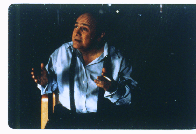
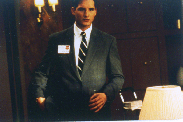 THE BIG KAHUNA takes place in a 16th-floor hospitality suite with
a view of Wichita. Here two veteran businessmen, Larry (Kevin
Spacey) and Phil (Danny DeVito), come together with newcomer
Bob (Peter Facinella) in hopes of reeling in a lucrative account - "the
big kahuna." As the men reveal their business philosophies and the
night progresses without bagging "the big kahuna," the true
personalities and emotions of each come to the surface, clashing and
co-mingling. The men face the next day with a greater understanding
of each other, their jobs, and themselves.
Spacey, as always, dominates the screen with the brash-yet-charming
character of Larry. Boldly speaking his mind and often offending the
neophyte Bob, he diffuses the tension with a conciliatory smile and
bad-boy appeal. DeVito exudes wisdom and gives Spacey a run for
his money in screen domination. Weariness and insight penetrate his
definition of honesty, which will blow you away. And Facinella as
the innocent newcomer holds his own among these stars.
Writer Roger Rueff has peppered his witty dialogue with
sophisticated humor and offers interaction that comes off totally
believable and natural. Director John Swanbeck enhances the
intensity with closeups and maintains a brisk pace. THE BIG
KAHUNA is a winner on all fronts - three superb actors, a few life
lessons (stay and "listen" to the closing credits - you're sure to make
a few resolutions of your own), and a story that both entertains and
enlightens.
-Laurie Lawson-
THE BIG KAHUNA takes place in a 16th-floor hospitality suite with
a view of Wichita. Here two veteran businessmen, Larry (Kevin
Spacey) and Phil (Danny DeVito), come together with newcomer
Bob (Peter Facinella) in hopes of reeling in a lucrative account - "the
big kahuna." As the men reveal their business philosophies and the
night progresses without bagging "the big kahuna," the true
personalities and emotions of each come to the surface, clashing and
co-mingling. The men face the next day with a greater understanding
of each other, their jobs, and themselves.
Spacey, as always, dominates the screen with the brash-yet-charming
character of Larry. Boldly speaking his mind and often offending the
neophyte Bob, he diffuses the tension with a conciliatory smile and
bad-boy appeal. DeVito exudes wisdom and gives Spacey a run for
his money in screen domination. Weariness and insight penetrate his
definition of honesty, which will blow you away. And Facinella as
the innocent newcomer holds his own among these stars.
Writer Roger Rueff has peppered his witty dialogue with
sophisticated humor and offers interaction that comes off totally
believable and natural. Director John Swanbeck enhances the
intensity with closeups and maintains a brisk pace. THE BIG
KAHUNA is a winner on all fronts - three superb actors, a few life
lessons (stay and "listen" to the closing credits - you're sure to make
a few resolutions of your own), and a story that both entertains and
enlightens.
-Laurie Lawson-
WOMEN (ELLES)
A WinStar Cinema release of a Samsa Film production
Directed by LUIS GALVAO TELES

Release date: October 29, 1999

Screenplay by    LUIS GALVAO TELES and DON BOHLINGER
Cinematographer  ALFREDO MAYO

                            Starring

 Linda..........................................................CARMEN MAURA
 Eva............................................................MIOU-MIOU
 Chloe..........................................................MARISA BERENSON
 Barbara........................................................MARTHE KELLER
 Branca.........................................................GUESCH PATTI

                            With

 Gigi...........................................................JOAQUIM de ALMEIDA
 Luis...........................................................MORGAN PEREZ
 Edgar..........................................................DIDIER FLAMAND
 Ines...........................................................MARIE GUILLARD
 Tiago..........................................................FLORENCE LOIRET
 Raquel.........................................................MAPI GALAN

     WOMEN is a new ensemble film which features an international cast in
     a story about coming to terms with desires, needs and intimacy.  The
     primary focus is on the lives of a group of five friends, each of whom is
     experiencing, by varying degrees, some sort of personal crisis.  Written in
     a manner which may seem to be less than pro-male through the course of
     the film, the script, by Luis Galvao Teles and Don Bohlinger, is tinged with
     realism and has a feel of authenticity.  Though the tone of the film is not
     anti-relationship per se, the characters of WOMEN, both the women and
     the men, often have cause to take issue with their respective partners.  Yet,
     even as they do, there is something hopelessly romantic about this film.

     Even when characters seem to be suffering, it is mostly do to what can best
     be described as love-sickness.  Aside from the fleeting relationship glitches,
     the audience is offered a sacrificial cow in the form of caterer, mother,
     divorcee Barbara (Marthe Keller).  Still in love with her ex-husband, and
     planning her daughter's upcoming wedding, Barbara falls seriously ill.  An
     unfortunate choice for this particular role, Ms. Keller, though good in the
     lighter moments, especially as part of the circle of friends, lacks credibility
     as a victim.  Her grief and torment seem forced and unreal.  Quite a
     surprise, she missed the mark.

     Another problem in the film is the underwritten part of Chloe, played by
     Marisa Berenson.  Little more than a cryptic, ex-junkie who lusts after
     friend Branca (Guesch Patti), Chloe is described more often than revealed.
     Her sexuality and history are never explored in more than a fleeting way.
     In comparison to the other four women, she is like a footnote.

     A few strained moments exist within the framework, but do not serve to
     cripple WOMEN.  Although the dying comrade motif seems trite and
     overused, it does not undermine this promising script.  The characters lives
     and stories are all intertwined, so that, in the end, everything comes
     together neatly.  Teles offers a welcome happy ending in a film that is full
     of sexual encounters, personal victories, and personal tragedies.  At the end,
     there is hope.  WOMEN could easily be dismissed as just another chick
     flick, but few of those not only feature actors of this caliber, but also a
     story that, far from a tear-jerking tragedy, is uplifting without being
     grandiose or extreme.

                    - Kessa De Santis -
Strand Releasing Presents
SHOW ME LOVE
Written and Directed by LUKAS MOODYSSON
Release date: October 15, 1999
Cinematographer ULF BRANTAS
Principal Cast
Elin.................................ALEXANDRA
DAHLSTROM
Agnes..............................REBECCA LILJEBERG
Jessica.............................ERICA CARLSON
Johan Hult.......................MATHIAS
RUST
Markus...........................STEFAN HORBERG
Olof................................RALPH
CARLSSON
Karin..............................MARIA HEDBORG
Oskar.............................AXEL
WIDEGREN
Birgitta............................JILL
UNG
Camilla............................LISA SKAGERSTAM
SHOW ME LOVE is a tale of teen angst with a decidedly
different spin.
Pretty, popular Elin (Alexandra Dahlstrom), is the
object of affection in an
unusual love triangle. Isolated loner Agnes
(Rebecca Liljeberg), and
average teen Johan (Mathias Rust), unbeknownst to each
other, are each
vying for Elin's attention. As the plot unravels,
in not really unpredictable,
but nevertheless, realistically crafted ways,
writer-director Lukas
Moodysson taps into the humanity of his
characters. These people seem
real. Even a scene depicting teens at a drunken
party never degenerates to
the point of presenting the characters as caricatures.
Holding the film up to a mirror of reality, it can be
faulted for presenting
many characters who are, perhaps, too generous of
spirit, and too
understanding. As Agnes' lesbianism enters the
public consciousness, she
is subjected to a degree of ridicule, and like many
teens in her position,
becomes suicidal. However, her peers, though mean
at times, are never
genuinely cruel, and her father (Ralph Carlsson), is so
attentive and
concerned for his depressed daughter, that hers seems
unlike the
experiences of most adolescents.
In terms of the structure of the work, all of the
elements are in place. Elin
is the type of girl who believes she will be a movie
star, shows a lot of
cleavage, and has a "reputation." She
spends a good deal of her time with
her sister (Erica Carlson), but fights with her
often. She laments the
limitations of her small town, Amal, despite her
popularity. Agnes is quiet
and cute, with a comparatively muted appearance, and
virtually no friends.
She has temper outbursts that are spurred by her
dissatisfaction with her
life, but she never seems hopeless. A relative
newcomer to Amal, she too
longs for something else, but what Agnes wants is to
fit in.
Moodysson's film comes across, ultimately, as
inherently optimistic.
Perhaps he is of the next generation of film makers,
for whom subjects like
a teen's coming out sexually will be a plot
complication and not an obstacle
to be overcome. In spite of the fact that SHOW ME
LOVE was originally
released under the title FUCKING AMAL, the film has
quite a positive,
if gooey ending.
- Kessa De Santis -
In Swedish with English subtitles.
Castle Hill Productions and Hawkeye Entertainment Present
A GIRL CALLED ROSEMARIE
A film by BERND EICHINGER

Release Date: October 15, 1999

Directed by               BERND EICHINGER
Produced by               BERND EICHINGER and USCHI REICH
Screenplay by             BERND EICHINGER and UWE WILHELM
Director of Photography   GERNOT ROLL

                              Cast
  Rosemarie..................................................NINA HOSS
  Hartog.....................................................HEINER LAUTERBACH
  Fribert....................................................MATHIEU CARRIERE
  Bruster....................................................HORST KRAUSE
  Marga......................................................HANNELORE ELSNER
  Christine..................................................KATJA FLINT
  Nadler.....................................................TIL SCHWEIGER
  von Oelsen.................................................HEINRICH SCHAFMEISTER

  A GIRL CALLED ROSEMARIE, based on the life of Rosemarie Nitribitt,
  a notorious character in 1950's Frankfurt, is an intriguing piece of
  filmmaking.  Created by first-time director Eichinger, this promising film
  was, remarkably, made for German television.  Audiences need not fear,
  however, because  the piece has none of the trappings or shortcomings that
  a U.S. audience would expect from a TV movie of the week.  In fact, had
  it not been publicized, there is nothing about A GIRL CALLED
  ROSEMARIE that would cause an audience to imagine that it was ever
  conceived of as anything but a feature film.

  Rosemarie Nitribitt, an orphan, and delinquent of sorts, eventually became
  a prostitute, a pawn in a nasty attempt at corporate blackmail, and the
  center of a sensational, unsolved crime.  A character who is essentially in
  search of love and a better life for herself, Rosemarie is ultimately a victim
  of her own ambitions.  In her unrealistic attempt to marry her lover,
  Hartog (Heiner Lauterbach), Rosemarie becomes trapped in a web from
  which she cannot escape.  Entrusting her future to a "benefactor," Fribert
  (Mathieu Carriere), she enters high society through the back door, all the
  while imagining that she can leave her sordid past behind and become a
  lady of high society.  Her union with Fribert has far-reaching and tragic
  results.  The path that leads her there is consistently engaging in this fine
  film.

  Eichinger's cinematic interpretation of Ms. Nitribitt's short, volatile life is
  dramatically solid and unflinching in its vision.  Although the series of
  upper-class men that constitute Rosemarie's client base each represents a
  type or caricature of sorts, for instance, a monocle wearing prince, Nina
  Hoss, as the title character, is quite impressive and genuine in her approach
  to the role.  She imbues the role with joie de vivre, and even splashes of
  humor.  The cast, as a whole, is filled with fine actors, and Eichinger, as
  director, creates a universe in which his heroine is truly the center of
  attention.  From the beginning of the film, when young Rosemarie, movie
  magazines in hand, is thrown into a workhouse, to the end, when she
  crashes a party decked out in Marilyn Monroe inspired attire and hair, we
  are drawn into her world of lofty dreams and grim reality.

  Perhaps the greatest achievement of A GIRL CALLED ROSEMARIE is
  that it leaves the audience wanting more.  The running time of just over
  two hours seemed to breeze by, and by the end I was hungry for the real
  story of Rosemarie Nitribitt, and for all of the details that were hinted at
  in Eichinger's film.

  In German with English subtitles.

                    - Kessa De Santis -
Merchant Ivory Films, in association with Artistic License Films presents
ON CONNAIT LA CHANSON (Same Old Song)

Written by AGNES    JAOUI and JEAN-PIERRE BACRI
Directed by ALAIN   RESNAIS

Opening October 15, 1999

                            Starring
PIERRE ARDITI       SABINE AZEMA       JEAN-PIERRE BACRI     ANDRE DUSSOLLIER
AGNES JAOUI         LAMBERT WILSON     JANE BIRKIN

     ON CONNAIT LA CHANSON (Same Old Song) would be rather
     standard fare were it not for the odd addition of random bouts of lip-synching
     which repeatedly replaces the dialogue in this film.  Filled with
     snippets of a seemingly endless number of what are probably popular songs,
     the film would surely be better received in France, where the tunes would
     be familiar to audiences.  Here they are an odd footnote to what is a good,
     though hardly extraordinary, film.

     Apparently, the convention of lip-synching is director Resnais' way of
     paying tribute to the late Dennis Potter, who also employed this tactic in
     such works as Pennies from Heaven and The Singing Detective.  As for ON
     CONNAIT LA CHANSON, the story does not seem to benefit from the
     addition of the music, but it is not so intrusive as to be an absolute
     detriment either.  At the core, the film is about very basic human
     interactions.  There is a love triangle, a cheating spouse, a hopeless
     optimist, a hypochondriac, a woman on the verge of a nervous
     breakdown...  And all of the elements and subplots are neatly and clearly
     resolved by the end.

     So, what writers Jaoui and Bacri, and director Resnais have created here
     really is the same old song. The script is good, the direction fine,the actors
     able, and game, but they are all singing a familiar tune.  There are no
     spectacular, transcending moments here, and there probably weren't meant
     to be.  ON CONNAIT LA CHANSON is an experiment, an homage, set
     to a decent story, and performed by some engaging people.  It is odd,
     strangely optimistic, and difficult to recommend.

                    - Kessa De Santis -
81/2
Directed by FEDERICO FELLINI

A Corinth Film Released by Kino International

Opening April 9, 1999
Exclusive engagement at the Paris Theatre (4 West 58th St.)
Screenplay
               FEDERICO FELLINI
               TULLIO PINELLI
               ENNIO FLAIANO
               BRUNELLO RONDI
Starring
               MARCELLO MASTROIANNI
               CLAUDIA CARDINALE
               ANOUK AIMEE
               SANDRA MILO

 Federico Fellini's 81/2, winner of the 1963 Academy Award for Best
 Foreign Language Film, is being rereleased for an exclusive theatrical
 showing.  A stunning, timeless achievement in filmmaking, it should not
 be missed. Beautifully and memorably shot, 81/2 explores the life of the
 main character, Guido (Marcello Mastroianni), from two different
 perspectives.  Here, reality and fantasy are at once distinctive and
 cinematically blended, so that Guido's story is told from the inside out.

 These different levels of perception give the film dimension without a
 great abundance of plot complications.  A good deal of the action takes
 place in Guido's mind, as he seeks resolutions through daydreams that
 could never be achieved in reality.  In his real world, Guido is a
 filmmaker who is struggling to complete his latest project. Situated at a
 spa where he has gone for a rest cure, Guido surrounds himself with
 colleagues, his mistress, Carla (Sandra Milo), and later, his wife, Luisa
 (Anouk Aimee).  Guido is a man who wants it all, but without the
 responsibility.  He lies to his wife about his mistress, and when she does
 not believe his explanation that the affair had ended three years prior,
 he retreats into an extended fantasy sequence.  In his mind, Luisa and
 Carla join hands, then the scene changes, and they become just two
 members of a bizarre harem, filled with all the female characters in the
 film.  In this place, the older women are banished to live upstairs, and
 even when they begin to revolt, they quickly quiet down, with Luisa
 adopting her matronly role and doing the "family" laundry.  These
 scenes give great insight into Guido's character.  When not reliving
 moments from his past, he engages in fantasy.  He seems desperate to
 flee reality, exuding an innate weakness to be definitive in the real
 world.

 Fellini created something delicious with this film.  It is a world of
 daydreams and odd encounters that has clearly become a template for
 avant-garde films to follow.  Fans of the cinema should not miss  81/2.
 It stands as a reminder of what creative filmmaking should aim to
 achieve.

                    - Kessa De Santis -
Fox Lorber Presents
A Hotwire/Complex Corporation Production
CONCEIVING ADA

Produced and Directed by LYNN HERSHMAN LEESON
Screenplay by LYNN HERSHMAN LEESON and EILEEN JONES
Release date: February 26, 1999

Starring TILDA SWINTON and FRANCESCA FARIDANY
CONCEIVING ADA is a technologically innovative film about a
computer programmer's (Francesca Faridany) attempt to create an
interactive dialogue with a virtual incarnation of Lady Ada Lovelace (Tilda
Swinton) who exists in the computer.  The premise starts out basic enough.
A person from this era wants not only to watch history, but to converse
with an important figure from the past.  Unfortunately, a promising idea
becomes muddled along the way.  While the scenes are pretty to look at,
the means by which programmer Emmy Coer interfaces with her hero is
never coherently or plausibly accounted for in the script.

The film has a great cast, which includes not only the two leads, but also
Karen Black, as the mother of both main characters, and the late Timothy
Leary, in an appropriately flaky role as Emmy Coer's mentor, Sims.  The
Sims character embodies the flaws in the science here.  His advice to Emmy
seems mystical and philosophical, but not at all technological.  Director
Lynn Hershman Leeson invented the "LHL Process of Virtual Sets" for
CONCEIVING ADA.  This seems to be a case where the quest to use new
methods to create the visual part of the film allowed the story to fall along
the wayside.

CONCEIVING ADA is an imagined biography of Lady Ada Lovelace.
Here, the life of Ada is far more interesting than that of her "conceiver,"
Emmy.  It is no surprise, then, that Emmy becomes obsessed with Ada's
life.  For the viewer, therefore, Emmy serves only as a hindrance to learning
about a much more interesting character.  The film would have worked far
better as a straight tale of Ada.  Imagined or not, Ada's biography is
titillating.

                    - Kessa De Santis -
|
Strand Releasing presents
     DRY CLEANING (Nettoyage a Sec)
     Directed by ANNE FONTAINE

     For release February 5, 1999

     Screenplay Dialogues by GILLES TAURAND and ANNE FONTAINE

     Starring MIOU-MIOU, CHARLES BERLING and STANISLAS MERHAR

  DRY CLEANING is a provocative tale of the undoing of a seemingly
  mainstream couple who become fatally involved with an alluring stranger.
  Nicole and Jean-Marie Kunstler (Miou-Miou, Charles Berling), owners and
  operators of a dry cleaning establishment, form an unlikely friendship with
  Loic (Stanislas Merhar), a transvestite performer, after seeing his act, and
  paying for his services as a "gigolo."  Through a series of events, Loic comes
  to live and work with the Kunstlers.

  These characters inhabit a dingy, dark world.  Jean-Marie, while meticulous
  in his profession, allows life to happen to him when it comes to personal
  matters.  He seems, at times, unwilling, perhaps unable to act, except in the
  extreme.  His inaction is one edge of the triangle.  Nicole embraces the
  novelty of Loic, and he becomes her sustenance to the detriment of
  everything she has known before.  Loic, an orphan, is sexualized and needy.
  Alternately crass and composed, the Kunstler's interest in him is credible
  as played here.

  As a screenplay, DRY CLEANING does not hold all that many surprises,
  despite the subject matter.  The "spontaneous" sexual encounters between
  Nicole and Loic are nothing new.  Jean-Marie's reaction upon witnessing
  the couple is not unexpected either.  Nothing that happens in DRY
  CLEANING, in fact, is out of step with the tone of the film.  That the
  events are not shocking makes the plight of the characters all the more
  evident.  The audience sees what they are stepping into ages before it
  happens.  Caught up in the ride, these characters are unable to see the
  pitfalls at every turn.

  That the characters are so credible is to the credit of the three leading
  actors, who each seems to be the person they are portraying.  Anne
  Fontaine's direction highlights the darkness that surrounds these
  characters, and which leads them to follow such doomed desires.  As a
  whole, DRY CLEANING can best be said to inhabit a world of its own.

  In French with English subtitles.

                    - Kessa De Santis -
Shadow Distribution Presents
A Paradis Films production
PORT DJEMA

Directed by ERIC HEUMANN

Opening December 11, 1998

Screenplay by ERIC HEUMANN and JACQUES LEBAS with LAM LE

                              Cast
          Pierre Feldman                     JEAN-YVES DUBOIS
          Alice                                   NATHALIE BOUTEFEU
          Jerome Delbos                      CHRISTOPHE ODENT
          Ousman                             EDOUARD MONTOUTE
          Soeur Marie-Francoise                   CLAIRE WAUTHION
          Antoine Barasse                         FREDERIC PIERROT

     PORT DJEMA is set in a small, East African country of the same name.
     Port Djema, a remnant of the French Empire, is in the midst of an ethnic
     war.  Told from the point of view of Dr. Pierre Feldman (Jean-Yves
     Dubois), who has traveled far from his Parisian home to fulfill a promise
     to a murdered friend, the film is gripping and subtly mysterious.  Set to
     beautiful music by Sanjay Mishra, and filmed by cinematographer Yorgos
     Arvanitas, PORT DJEMA is quite a package.

     As Pierre makes his way around the region, searching for a child once
     looked after by his deceased friend, Dr.  Antoine Barasse (Frederic Pierrot),
     he is soon thrust into the heart of the conflict.  Within days, he has walked
     in his friend's shoes, despite warnings and the apparent dangers that await
     him at every turn.  On his journey he meets Alice (Nathalie Boutefeu), a
     photographer who shoots shadows and remnants.  She photographs not the
     people caught up in the conflict, but the things they leave behind.  Also a
     friend of Antoine's, Alice is like a shadow herself, appearing to be
     incidental in most scenes, but ultimately of great significance.

     This story is cleverly told from the viewpoint of Pierre, a character
     relatively unfamiliar with the politics and goings-on in Port Djema.  The
     details of the conflict are minor here.  The real focus of PORT DJEMA is
     the journey that one man must make, physically and spiritually, in
     fulfillment of a promise.  The real tale is a cerebral one, about what Pierre
     learns along the way.

     PORT DJEMA is a thoroughly watchable film.  The acting, writing,
     directing all come together to make this something worth seeing.

                   - Kessa De Santis -
AMKO PRODUCTIONS, INC. PRESENTS
SUE
AN AMOS KOLLEK FILM

Opening November 20, 1998

Starring ANNA THOMSON as Sue

                              Cast
          Ben                                MATTHEW POWERS
          Lola                               TAHNEE WELCH
          Linda                              TRACEE ROSS
          Larry                              JOHN VENTIMIGLIA
          Eddi                               EDOARDO BALLERINI
          Sven                               MATTHEW FABER
          Willie                             ROBERT KYA HILL
          Interviewer                        DECHEN THURMAN
          Sydney                             JOSHUA KAPLAN
          Phil                               LAZARO PEREZ

     SUE is a film about loneliness and desperation.  Set in New York City, it
     explores the way in which an individual can be alone, by choice or chance,
     even in the crowds of a populous city.  Though far from uplifting, the film,
     written, directed and produced by Amos Kollek, is not without charm, wit
     and humor.  Anna Thomson plays Sue with alternating currents of
     sexuality and disintegration, but always with the destructive quality of her
     actions in the forefront.

     The action follows Sue through a series of random meetings with strangers,
     most of them sexual.  As her desperation and alienation mounts, she seeks
     out more unlikely companions, even as she pushes aside her chances for
     real friendship and love.  Along the way, Sue encounters Lola, a thief and
     prostitute, engagingly played by Tahnee Welch, a psychology student
     (Tracee Ross), and a maybe-boyfriend, Ben, credibly portrayed by Matthew
     Powers.  Even Austin Pendleton makes a brief appearance as a man who
     mistakes Sue for a prostitute.  Many of Sue's encounters are destructive,
     but even when she is fortunate enough to happen upon those who seem to
     genuinely care for her, she is unable to make the choice that will improve
     her life.

     That, in a nutshell, is SUE.  The actual plot complications revolve around
     her desperate attempts to secure employment and keep her apartment, but
     the meat of the movie is the ongoing series of random meetings that
     characterize the transiency of Sue's relationships, the genuine isolation that
     she experiences.  Anna Thomson is affecting as Sue.  Sometimes alluring,
     sometimes repugnant in her desperation and decline, Ms. Thomson has
     captured a soul past the brink, on the verge of hitting the ground.

     The darkness of this film is palpable, but lightened enough to make it more
     real than wrenching.  SUE won't bring you to tears, and it won't make you
     want to go out and hug every lonesome stranger that crosses your path, but
     it is an interesting little story.  It will probably make your own life seem a
     whole lot brighter.

                    - Kessa De Santis -
RIVER RED
A New Film by ERIC DRILLING
Opening November 6, 1998 at The Quad
Starring
TOM EVERETT SCOTT, DAVID MOSCOW, CARA BUONO,
LEO BURMEISTER, DAVID LOWERY
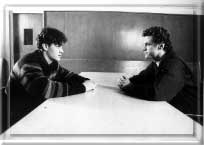 Dave (Tom Everett Scott) and Tom (David Moscow) Holden are the
victims of a cruel father. As the younger brother, Tom takes the brunt
of abuse until one fateful night when Dave kills his father. To protect
his older brother from a jail sentence, Tom takes the blame for the
murder and is sentenced to two years in a juvenile facility. Dave is
free from jail but not from his conscience and the guilt of his deeds.
As Tom pays the penalty for a crime he did not commit, Dave
punishes himself by turning to a life of crime and isolating the people
who want to help, including his new-found girlfriend Rachel (Cara
Buono).
RIVER RED is supposed to be a film about passion, the bond
between brothers, and the human need to redeem ourselves. The
viewer must make many leaps in order to reach these conclusions. We
do not witness enough violence or its aftermath to justify a murder.
After the crime has been committed, the reactions of the brothers are
almost matter of fact. A condition of shock and denial can be
warranted immediately following the deed, but for the majority of the
film Scott and Moscow interact in a mono-syllable, semi-comatose
state. Finally after Moscow is released from the juvenile facility, a
multi-faceted personality emerges, and his effort to save his brother is
touching.
RIVER RED is a fine story of parallels and contrasts. Unfortunately,
it lacks intensity, suspense, and anything with which we could
empathize. Its attempts to be arty consist of bucolic scenes by a
tranquil river, the obnoxious cawing of a bird, and several scenes of
wood chopping. It does possess some fresh and moody music by
Johnny Hickman and a fine acting debut by David Lowery, both
from the platinum-album recording group CRACKER. But unless
you have actually killed your father, you're probably going to walk
away from this one unmoved.
-Laurie Lawson-
Dave (Tom Everett Scott) and Tom (David Moscow) Holden are the
victims of a cruel father. As the younger brother, Tom takes the brunt
of abuse until one fateful night when Dave kills his father. To protect
his older brother from a jail sentence, Tom takes the blame for the
murder and is sentenced to two years in a juvenile facility. Dave is
free from jail but not from his conscience and the guilt of his deeds.
As Tom pays the penalty for a crime he did not commit, Dave
punishes himself by turning to a life of crime and isolating the people
who want to help, including his new-found girlfriend Rachel (Cara
Buono).
RIVER RED is supposed to be a film about passion, the bond
between brothers, and the human need to redeem ourselves. The
viewer must make many leaps in order to reach these conclusions. We
do not witness enough violence or its aftermath to justify a murder.
After the crime has been committed, the reactions of the brothers are
almost matter of fact. A condition of shock and denial can be
warranted immediately following the deed, but for the majority of the
film Scott and Moscow interact in a mono-syllable, semi-comatose
state. Finally after Moscow is released from the juvenile facility, a
multi-faceted personality emerges, and his effort to save his brother is
touching.
RIVER RED is a fine story of parallels and contrasts. Unfortunately,
it lacks intensity, suspense, and anything with which we could
empathize. Its attempts to be arty consist of bucolic scenes by a
tranquil river, the obnoxious cawing of a bird, and several scenes of
wood chopping. It does possess some fresh and moody music by
Johnny Hickman and a fine acting debut by David Lowery, both
from the platinum-album recording group CRACKER. But unless
you have actually killed your father, you're probably going to walk
away from this one unmoved.
-Laurie Lawson-
CHICAGO CAB
A GFT Entertainment Film Released by Castle Hill Productions and Dream LLC

Adapted from the play "Hellcab" by WILL KERN
Directed by MARY CYBULSKI and JOHN TINTORI
Produced by PAUL DILLON and SUZANNE DeWALT


          Screenwriter Will Kern used his personal experiences as a cabdriver
          on the streets of Chicago to write his award-winning play "Hellcab."
          From this emerged the film CHICAGO CAB, a humorous and
          poignant trip that follows a day in the life of a cab driver with some
          very strange passengers.  Paul Dillon, who also portrayed the driver
          in the play, is a bit eccentric with subtle similarities to Christopher
          Lloyd's Reverend Jim character in the television series Taxi. He's
          lonely and socially inept but basically a guy trying to do the right
          thing.  Into the back seat of his cab comes an array of characters that
          would plague anyone's day.  John Cusack is a menacing oddball who
          demands transportation to a dark alley; Laurie Metcalf and her illicit
          lover have sex on the way to the hotel; an impertinent and
          promiscuous Gillian Anderson fights with her boyfriend; and a heart-wrenching
          Julianne Moore calmly accounts being brutally assaulted.

          What these and several other passengers reveal is how the cab driver
          becomes a small, short part of their lives.  Their stories are abruptly
          interrupted and have no conclusion; then he moves on to another.  He
          empathizes but usually cannot influence or alter the outcome.  The
          camera shots are close and tight, depicting the physical proximity of
          driver and passenger.  Within that small space, he is subjected to
          prejudices and passions, threats and propositions, and a plethora of
          emotions. Those looking for a plot or solutions to the problems of
          mankind will be disappointed.  What you get instead is a glimpse into
          a profession that randomly encounters all kinds of people;
          CHICAGO CAB is a fine slice-of-life film.

               -Laurie Lawson-
LITTLE BOY BLUE
A Film by ANTONIO TIBALDI

               Starring

            RYAN PHILLIPPE
            NASTASSJA KINSKI
            JOHN SAVAGE
            SHIRLEY KNIGHT

Director:                ANTONIO TIBALDI
Writer:                  MICHAEL BOSTON
Cinematographer:         RON HAGEN, A.C.S.
Production Designer:     JOHN FRICK
Editors:                 ANTONIO TIBALDI and TOBIN TAYLOR
Music Composer:          STEWART COPELAND
Music Supervisor:        FRANK FITZPATRICK
Costume Designer:        APRIL FERRY


LITTLE BOY BLUE is a dark film about love, perversion,
criminality, revenge, and survival against all odds.It is also one of the
most bizarre stories ever.

Jimmy (Ryan Phillippe of I Know What You Did Last Summer fame)
is a nineteen year old with a promising baseball pitch and a girlfriend
named Traci (Jenny Lewis).  And these are the only rays of hope in
poor Jimmy's life. His father Ray, a former Vietnam veteran tautly
portrayed by John Savage, is sadistic and prone to violence.  His
mother (Nastassja Kinski) is not immune from Ray's abuse, but the
ties that bind them are deep rooted. Jimmy also has two younger
brothers (marvelously portrayed by Devon Michael and Adam Burke)
who have learned how to survive in this unhealthy environment.  Into
their already-turbulent lives comes a woman (Shirley Knight) from the
past hell-bent on revenging years of suffering.

LITTLE BOY BLUE is raw and gritty, as stark as the dilapidated
trailer that houses the family's sordid secrets. Antonio Tibaldi keeps
the tension level high.  Nothing is as it seems, and at every turn there
is a surprise that challenges your credibility. But as the story twists
and turns, you absorb the latest revelation and anxiously await the
next. There's not an ounce of predictability in this one; its debauchery
at its best.

               -Laurie Lawson-
  CARLA'S SONG
  Directed by KEN LOACH

  A Channel Four Films Presentation
  Released by Shadow Distribution May 15, 1998
  Starring ROBERT CARLYLE, OYANKA CABEZAS and SCOTT GLENN

  Screenplay by PAUL LAVERTY
  Produced by SALLY HIBBIN
  Director of Photography BARRY ACKROYD
  Composer GEORGE FENTON

Carla's Song, set in 1987, traces the budding, unlikely love story of
a Scottish bus driver and a Nicaraguan refugee. The action begins
on a bus in Glasgow, as the unconventional driver, George (Robert
Carlyle) comes to the aid of a mysterious passenger (Carla, played
by Oyanka Cabezas) when she is caught without a ticket.  Through
a series of coincidences and persistent actions on George's part, the
two become involved. Eventually, in an attempt to understand his
troubled new love, George takes Carla back to her homeland.  Here,
amid the Contra's continuing assault on the Sandinistas, he comes
to have a greater understanding of her life.

George is the ultimate nice guy, taking on what is an obviously
complicated situation when he befriends Carla. The premise here,
while bordering on the implausible, seems completely credible and
reasonable as it evolves in Carla's Song. Robert Carlyle gives George
life, and his actions seem credible.  Oyanka Cabezas' performance is
compelling and appropriately restrained. The supporting cast is
good. Although, Scott Glenn as an ex-C.I.A.officer now supporting
the Sandinistas is in the unfortunate position of having to deliver
the only quasi-p.c. dialogue in the script. He acts as the vehicle by
which the politics of the war are explained, which, while a necessary
exposition, could have been executed better.

This is an interesting story that covers new ground.  A minor
difficulty for speakers of American English will be the Scottish
English prevalent in the first half of the film.  Although distracting,
the action is clear enough to make a word for word comprehension
of the dialogue unnecessary.

Carla's Song is a love story that moves in unlikely directions, and a
film that traces a difficult journey.  Sometimes endearing, sometimes
tragic and horrifying, it is never bludgeoning. Political, yes, but
there is a legitimate context in the form of a well-crafted tale of the
human spirit and what it can endure to deliver the message.

                   - Kessa De Santis -
|
Fox Lorber Features presents

LIFE OF JESUS (LA VIE DE JESUS)
A film by BRUNO DUMONT

Bruno Dumont's LIFE OF JESUS (LA VIE DE JESUS) has picked
up a few awards, including last year's Cannes Film Festival Winner
of the Jean Vigo Prize for Best First Feature, the International
Critic's Prize at the 1998 Chicago Film Festival, and the Official
Selection at the New York Film Festival, before it opens at Cinema
Village (22 East 12th Street) on May 15th. It is a stark and gritty film
- in the first five minutes you witness tragedies in Rwanda via a
television in a small bar, a friend dying of AIDS in a hospital, and an
epileptic fit. Under Dumont's direction, Phillippe Van Leeuw's
camera does not blink, and neither do you.

Set in a small village in Northern France, Life of Jesus relentlessly
follows the uninspiring lives of Freddy (David Douche), a 20-year-old
prone to epilepsy, and his four friends.  The boys are unemployed,
minimally educated, spiritually deficient, and lacking in initiative.
Their boredom is broken only by aimless trips on motor bikes,
attempts to teach a soundless finch to sing, and perfunctory love
making. Freddy's only passion is his girlfriend Marie (Marjorie
Cottreel), but even that relationship lacks sensitivity.  As the scenes
flit from one scenario of tedious activity to another, you begin to feel
the boys' restlessness and boredom. You find yourself wishing that
one of them would take action to change their lives (indeed, you
silently cheer as the young Arab Kader Chaatouf boldly pursues
Marie), but because these characters are totally powerless over the
events that influence them, the actions they do take are crude,
insensitive, and eventually violent.

Life of Jesus is a masterful study of youth bereft of choices, the
resultant monotony and racism, and its violent response.  It is a true
portrayal of characters with long and uncomfortable closeups, silence,
and subdued action - even the violent scene is short and passionless.
Amazingly the effect is mesmerizing as you follow along with the act
of living, no matter how random it may be. Dumont offers no
promises of redemption or easy pat solutions; instead, he submits a
chillingly realistic slice of life.

               -Laurie Lawson-
CHARACTER
Directed by Mike van Diem
Screenplay by Mike van Diem
in cooperation with Laurens Geels and Ruud van Megan

From Sony Pictures Classics, to be released March 27, 1998
Starring Fedja van Huet, Jan Decleir and Betty Schuurman

Character is set in 1920's Rotterdam, but this dark tale could be set
in any time or place and be as affecting.  The story unfolds through
flashbacks, gradually revealing the complex events that have led the
central character, Katadreuffe (Fedja van Huet), to be arrested for
the murder of the fearsome, dreaded bailiff, Dreverhaven (Jan
Decleir). As Katadreuffe conveys his version of events to the police,
which entails recounting the pivotal moments of his entire life,
including his discovery that Dreverhaven is his father, the richness
of Character emerges, right from the start.

As the omnipresent Dreverhaven, Decleir uses his physicality to
dramatic advantage. A large man, his brooding presence hints at the
best and worst elements of his character, even when he is seemingly
docile. As Katadreuffe, a man heavily burdened by the tenuousness
of his situation, van Huet often looks distraught, but never
overcome. As his mother, Joba, Betty Schuurman gives a subtle,
nearly silent performance. Her very presence, complementing
Dreverhaven's, speaks volumes although she says nothing at all.
Joba's subtlety balances Dreverhaven's voracity. The effect is a
compelling, well-acted film.

Under Mike van Diem's direction, Character becomes a study of not
only the characters in the story, but of the location.  The look of the
film sets a definite mood, an overall darkness, tempered for
moments by hope, light and beauty, that is right in line with the
subject matter. Character is a complex, intriguing tale, and definitely
worth a look.

                   - Kessa De Santis -
THE DRESS
A Film by ALEX VAN WARMERDAM

Director: ALEX VAN WARMERDAM
Screenplay: ALEX VAN WARMERDAM
Cinematography: MARC FELPERLAAN
Costume Designer: LEONIE POLAK
Original Score: VINCENT VAN WARMERDAM

Opening: January 16, 1998
Running Time: 103 minutes

Alex van Warmerdam's THE DRESS follows the escapades of a
colorful swatch of material that changes hands (and bodies) many
times in its short life.  Perhaps even more colorful are his quirky
characters.  There's an aging housewife who does herself in with a
bolt of lust, a young sexually frustrated housemaid who attracts
sexually-perverted gentlemen, an innocent school girl who takes a
fateful ride in the dress, a homeless woman, and a ticket collector who
becomes possessed by the dress and all who wear it.

Van Warmerdam keeps the pace going by constantly presenting
preposterous situations and interweaving the catastrophes of the
characters.  The humor is zany and sophisticated.  And he gives the
dress a life of its own.  Even after it is part of a cremation ceremony,
it still lives on.  Nudity, sexual encounters and battles, insanity, and
tragedy are all a part of his delightful adventure.  To blend these
incongruent elements and manage to make the audience laugh is quite
an impressive feat.

THE DRESS has received the International Film Critics' Award at
the Venice Film Festival and the Dutch Film Critic's Prize Best Dutch
Film at the Netherlands Film Festival.  This is a film worth seeing.

               -Laurie Lawson-